Thursday, April 6, 2017

Love, in Four Words


Overseen in Roma Norte-"Full belly, happy heart."
I´d like to think that food classifies as it´s own love language. 

    One of my favorite aspects about living an immersive language experience is learning more about how linguistic differences are both born from and reflect cultural differences. Although Spanish and English are similar languages in many ways, (both use the same alphabet, generally similar grammar structure, etc...), there are also many differences. One of the greatest differences I have noticed is that in Spanish, there are more nuanced ways to express things, with more specific phrases and terminology for a concept than exist in English. 
  A recurring conversation I have had with Nef and Danny, friends, coworkers, and other members of my host community, is how one of the most universal experiences is expressed differently in English and Spanish: love. In Spanish, there are four different verbs that can be used to say "like/love": gustar, encantar, querer, and amar. Gustar is more often used for objects/activities, not people, and translates to "like": for example, Me gusta tocar el piano-"I like to play the piano". Encantar, would translate to "enchant", and is also used as "like", but in a stronger way-generally, also for objects/activities, and not people. Me encanta tocar el piano would be more equivalent to saying "I really, really, REALLY like playing the piano". Querer translates to "want", but is also used when you tell someone you love them-Te quiero. However, this is where a key linguistic and cultural difference plays in.

     The other, stronger way to say “I love you” is Te amo, from the verb amar. When I was in Spain, I was told that Te amo was something only reserved for between romantic partners-in Spain, you would never say Te amo to your parents, for example. But here in Mexico, saying Te amo can be used outside of a romantic context, and implies a deeper connection, whereas Te quiero is a phrase that doesn't quite translate in English. Te quiero means "I love you", but, for me, would translate more specifically to "I have deep feelings of affection for you and really, really care about you".

    When people ask me what are my favorite things about Mexico, I talk about my host community and the warmth of the culture here. The stereotype held by some Mexicans of US Americans is that we are a more reserved, less demonstrative culture, which I believe is reflected in our use of the word "love". My uncle, who is British, was very critical of that aspect of US culture when he first starting dating my aunt. She remembers him commenting to her in their early days of dating, "Jen, if you say you love chocolate, and then say you love me, how am I supposed to know you feel differently about chocolate than about me if you use the same word? You Americans use the word love too freely."

    On the other hand, people here are often surprised when I say that although in the US we use the word "love" very freely when describing our liking of a food, band, movie, etc...we don't have the Te quiero equivalent, and telling someone who is not a romantic partner or family member "I love you" can sometimes come off as awkward. When I was talking to Danny about my roommates´ visit, he was shocked to hear that I didn't say "I love you" to three of my closest friends.
    "Well," I told him, "in my experience, in US culture, sometimes saying “I love you" to someone who is not your partner or a family member can come off as a little strong".
    "But if you don´t tell them you love them, how do they know?", he responded.
     Which got me different about all the different ways that I have seen love expressed and received, both personally and within my host communities, even when the words “I love you” weren't directly spoken. I think that, regardless of cultural context, it is important to recognize and respect how people prefer to be loved and cared for. Some people specifically need to hear hear “I love you”-for others, a better expression of love could be someone helping them with the laundry. I grew up in a family that greatly valued physical affection-my mom's best friend once commented that my family was like a litter of puppies when we are all together. Here in Mexico, personal space bubbles are smaller (and not just on the metro at rush hour), and a common greeting between women or between a man and a woman is a kiss on the right cheek and a hug. As someone who thrives on physical affection, I quickly became comfortable with this cultural difference, but I have heard from other US-expats that it took them more time to get used to it. Looking back on the arc of this year so far, and forward towards the three months I have remaining, it has been beautiful for me to look back on the many specific ways I have received and continue to receive love this year:
  • When my friends Luis and Aymet drove 40 minutes out of their way to drop me off at my house, just to make sure I got home safe
  • When my friends Clem and Daniel invited me to go dancing with their group of friends at the beginning of my year, when they knew I was feeling a little lost and lonely
  • When my friend Anabel took the time to take me to her favorite taco place in the city after work, despite the traffic and the rain 
  • When my co-worker Noé learned I had studied piano, and insisted we form an office band
Jamming with the Eucumenical All-Stars 
  • When our office chef, Doña Marie, shows concern when I don´t try all of the dishes at lunch
  • When Antonia, my pastor´s wife, welcomed me in and took care of me for a weekend after I had spent that Friday up all night with food poisoning 
  • When my pastor, Miguel, updated me on the UNC-Oregon score this past Saturday when I couldn't watch the game, and invited me to watch the NCAA final at his house (and fellow Tar Heels, if that is not true love, I don't know what is)

Prepping for a Tar Heel victory 
With my favorite honorary Tar Heel 

  • When my friends Sonia and Noemi invited me to their home in Tlaxco for a weekend and made me feel like family
Visiting Sonia and Noemi´s family in Tlaxco. 

Celebrating Sonia and Noemi´s new book!
  • How the staff at the CEE greet every single person with a hug when they arrive, and insist on taking the time to celebrate every birthday with cake and gelatina
Celebrating an office birthday. 
  • The time, money, and energy my three college roommates spent to come down to Mexico City for a week
With my roommates at Castillo de Chapultepec. 
  • The accompaniment of my friends in the States and in other YAGM countries, via FB messages, Whatsapps, and and waking up early/staying up late for blurry Skype calls 
  • The unwavering support of my parents and family, who have always inspired me to keep exploring, even when that means being far from them
Hanging with my families. 
  • The calm reassurance and encouragement of my boyfriend Garrett, who has encouraged me to pursue my dreams, not just this year, but for the past four

Exploring Teotihuacán with Garrett.
  • Celebrating the twins´ first birthday with my country coordinators  
  • When my fellow YAGMex volunteers take the time to check in with me, sharing in both the good moments and the bad
YAGMex fam at our Xmas celebration. 
  • The sense of community in my church here in Mexico, Iglesia Luterana del Buen Pastor, as well as emails and messages of support from my church communities back in NC

My church community at Iglesia Luterana del Buen Pastor, celebrating a baby shower.
  • I could have written an entire list just of the ways that Nef and Danny have loved and cared for me this year-Nef insisting that I eat a fifth piece of toast, doing a ridiculous dance in the metro to cheer me up when he knows I´ve had a rough day, and telling me to put on a sweater because "Hace frio", even when it's 65 degrees outside; Danny brushing my hair, taking the time to cook the best enchiladas I have ever had, because he knows they are my favorite, and telling me that everything will be ok; staying up late to talk with me even when they are bone-tired from work; spending the day together in Los Dinamos, even when Nef had approaching exams; helping me with my grammar; every time they call me their hija; the hospitality they have shown to my visitors; listening to me and supporting me as I wrestle with personal and professional discernment; and all the hugs, laughter, jokes, meals, metro rides, museum visits, church services, tears, dishwashing, and (extra)ordinary moments we have shared these 8 months. If I know anything for certain from this year, it is that God was watching out for me when S/He made the three of us us a family.

Danny´s enchiladas!


Hanging out at Parque Nacional de los Dinamos 

Mis corazones 

    In our YAGM orientation in Chicago, YAGM staff and alum encouraged us to find "the magnificent in the mundane"-the hand of God moving in small, everyday moments. Although these moments listed here may not be earth-shattering or make any sort of news, they are the threads that form the fabric of my life and experience here. With far less time ahead of me than behind in my year here, it can be easy for me to get too caught up in planning future next steps. However, I know that part of my call this year is to be fully present as much as I can until I board that plane back to NC on July 7th. Until then, I find hope and strength in all the different ways I have been loved during my year here, and from a quote I recently taped to my mirror:

"No longer forward nor behind
I look in hope or fear
But, grateful, take the good I find
the best of now and here."'
-John Greenleaf Whittier

Wednesday, February 1, 2017

On Stomach Bugs and Immigration Bans

Protesters at JFK International Airport-image from the New York Times. 

Dear friends,

Greetings from México City! Since my last post, I have enjoyed the holidays, receiving visitors, and celebrating Christmas and the New Year's with my host community. It is mind-blowing to me that we are already in February, and that I am quickly surpassing the halfway mark of my year. YAGM staff were correct in telling us at our Chicago orientation that this year would be the fastest of our lives! As much as these past few weeks have been filled with joy, they have also been filled with great political uncertainty, both in the US and here in México. México has awaited the Trump administration with trepidation, as the economy suffers blows from the 45% increase in gas prices (known here as the gasolinazo), peso hitting historic lows, a growing humanitarian crisis along the border, and fear as Trump takes steps to proceed with the infamous wall along the US-Mexican border. It has been a very strange week and a half for me as a US citizen abroad watching the incessant stream of news from the Trump administrative: infringements on reproductive rights; threats to health care access; signing of the executive order to build the border wall; the first official press conference marked by “alternative facts”; a federal probe of voter fraud; attacks on the press and scientific community; taking steps to proceed with the Dakota Access Pipeline; and now a temporary ban on refugees and people from 7 predominately Muslim countries. Merely typing that sentence left me overwhelmed, much less thinking of the very real consequences for so many people. But before I get into any of that, I want to share a story from this past week:
It is widely known that, although Mexican food is delicious, that sometimes foreigners literally can't “take the heat", and the strong flavors and spices can provoke upset stomachs, or “Montezuma´s revenge”, referring to a former Aztec emperor. Thankfully, this year, I have not had any issues with the food, including the delicious, if at times slightly questionable, street food. Or, I hadn't had any issues, before this past Thursday. Although I went to bed feeling fine, I woke up a few hours later profusely sweating, shaking, and realizing that I was going to quickly see my meals a second time round. And I did see them, several times throughout the night, until my stomach was finally empty. Thankfully, I was finally able to sleep, and woke up a few hours later feeling mostly fine.

My host dads had both happened to be out of town that night, and were very concerned when I informed them of my stomach bug, insisting that I stay at my pastor´s house for the weekend while they had to work. Although I come from a cultural context that encourages minimizing and shrugging off illness (I'm fine, I'm fine!), not to mention the exorbitant cost of health care for so many people in the States, I decided to take them up on the offer. I arrived at my pastor´s house to be welcomed by the warm arms of Toña, our pastor´s wife, and my unofficial Mexican mami. I went straight to bed, and woke up to find that she had prepared rice, Jello, and had brought juices for me while my stomach recovered. I spent the weekend with her, her kids, and my fellow YAGM volunteer Justin hanging out, shooting the breeze, watching Netflix, and helping get ready for church that Sunday. That weekend of rest and being in community not only helped my stomach recuperate, it warmed my soul.
At first glance, this story is a fairly normal, ordinary experience-people get stomach bugs all the time. For me, however, it is an example of what YAGM staff  had urged us to look for in our years-the holiness in the everyday moments, God manifest in the mundane. For me, this story is representative of the community that has welcomed me here-the concern of my host dads, my pastor´s wife who took care of me, my pastor who called from a conference in Chicago to see how I was doing, and my coworkers and congregation members from my church who checked up on me. For me, it is nothing short of miraculous that only after a few short months, I have a community that has washed me with love, that has accompanied me every step of the way.

The idea of accompaniment is core to the YAGM philosophy and a vein that runs throughout all aspects of life in México. “Te acompaño” or “I accompany you” is a common phrase, that both means literal physical accompaniment of someone to the store, market, etc.., but also an emotional accompaniment. It is knowing that you don't have to go it alone, that we are inherently communal, social creatures. The idea of “Yo no soy si tu no eres”: ”I am not me if you are not you”-that we are all inherently dependent on each other. It is an idea that runs very contrary to US culture, a culture that values independence, self-reliance, and individualism-think the image of the lone ranger, the cowboy riding off into the distance, “pulling yourself up by your bootstraps”, etc...At first, this idea was jarring to my US-based, preconceived idea of what it means to be someone coming into their young adulthood. However, this year has been a lot of self-critique and pride-swallowing, of being dependent on others for emotional, physical, and linguistic support, of admitting to myself that is ok to let my guard down, to be honest when things aren't fine, of being more willing to receive help.

“The alien who resides with you shall be to you as the citizen among you; you shall love the alien as yourself, for you were aliens in the land of Egypt” (Leviticus 19:34).

“You shall not deprive a resident alien or an orphan of justice” (Deuteronomy 24:17).

In wake of the recent immigration/refugee ban, I have seen these and similar verses being shared frequently on social media. These verses have newfound meaning for me this year, particularly the one from Leviticus. This year, I am the alien in the strange land-the alien that looks different, has a funny accent, makes a lot of grammatical errors, does not fully understand local customs, and sometimes has no clue what´s going on.  However, unlike so many of those who will be affected by this new ban, I have all the privileges of being a white, upper middle-class, straight, college-educated US citizen. As my fellow YAGM volunteers and I prepare for our upcoming retreat to the US-Mexican border, the power of my blue passport is not lost on me as I think of all those who were recently turned away from airports both in the US and abroad, while I will be able to enter that airport and cross that border with ease. My heart breaks reading stories of those who had worked for years, and upon receiving the visa, sold everything, left their jobs and communities, pulled their kids out of school, and spent thousands of dollars on flights, only to be turned away upon arrival. For the ones who endured hours of uncertainty in airports while waiting to reunite with their loved ones, while I know that come July, I will be able to reunite with my family with ease. For those who will not be able to save their families from brutal warfare and bloodshed, such as that which was seen in Aleppo just this past December. For our Muslim brothers and sisters in the US who fear future Islamophobic retaliation. This ban goes against the values we hold as a country-of welcoming “...your tired, your poor, your huddled masses yearning to breathe free...¨, of diversity as our strength, of giving refuge to those who need it.

As children of God, we are called to accompany and to stand in solidarity with the most vulnerable, the most oppressed of our society: “the preferential option for the poor”, as it´s known in liberation theology. Just as my community accompanied me so beautifully during my stomach bug, we are called to accompany those who are fleeing some of the most brutal conditions on earth, those for whom this ban is truly a matter of life and death. As a church, we must denounce this ban which goes so clearly against what Jesus calls us to do. As Bishop Eaton wrote in her statement on the ban, "In Matthew 25:35, Jesus said, "I was a stranger and you welcomed me". Our Lord not only commanded us to welcome the stranger, Jesus made it clear that when we welcome the stranger into our homes and our hearts-we welcome him". As a stranger in a strange land who has been the recipient of radical hospitality, I pray that our country takes swift and decisive action against this ban, and does not abstain from showing welcome to those who need it most.

"Do not forget to show hospitality to strangers, for by so doing some people have shown hospitality to angels without knowing it."-Hebrews 13:2

Interested in ways to take action? If you are financially able, consider donating to one of many excellent organizations that support refugees, such as the ACLU, Lutheran Disaster Response, or many others such as the ones listed here and here. Contact your representatives, and contact them frequently-calling is much more effective than email, online petitions, or facebook statuses/tweets. Check out the website 5 Calls, which provides scripts and contact information to help you take 5 minutes to make 5 calls to your representatives. (And check out their many sources to see why calling is one of the most effective ways to get your voice heard).

Wednesday, December 14, 2016

Give thanks

Dear friends,
    Holiday greetings from CDMX! I hope you are all enjoying the winter weather, whether that be cold and snowy or otherwise, and the holiday preparations. Although Mexico City is anything but cold and wintery (highs are generally in the mid-70s lows in the mid-40s), the city is embracing the holiday spirit, with Christmas lights, ice-skating rinks, artificial snow, and even a fake hill in the city center for kids to sled down. I have been busy getting ready for holiday celebrations with my host community-for my church´s Christmas posada (a re-enactment of the Christmas story) and my office's Christmas party, where your's truly will be performing with the office band, Los Ecumenical All Stars. As much as I have enjoyed getting ready for the holidays, I have been hit with occasional pangs of homesickness, knowing that this is my first holiday season away from home. However, I wanted to share an experience from our first YAGM group retreat that impacted me strongly, and and threw my experience of being away from home during the holidays into a whole new perspective.

    One of the many strengths of the YAGM program is that it intentionally works to build community, not only within our host communities, but also within the group of volunteers. YAGM volunteers regroup three times during the year for week-long retreats in order to rest, bond as a group, and share our experiences. This November, I spent Thanksgiving week with the other YAGM-Mexico volunteers and our country coordinators in the gorgeous state of Tlaxcala. After a few months in the city, it was wonderful to get out into the mountains, breath fresh air, and be outside of the traffic and congestion for a few days.

Some of the lovely Tlaxcala landscape. 
  
  Although I was excited to spend Thanksgiving with the other volunteers and our country coordinators, I felt pangs of homesickness in thinking of my family back at home. Thanksgiving in my family is a borderline sacred affair, with a spread of food of Southern Living magazine proportions. As a southerner, I associate Thanksgiving with fried turkey, cornbread and oyster stuffing, sweet potato soufflé, collard greens, and two types of cranberry sauce (one fresh, and the other that still has indentations from the can). Mostly though, I associate Thanksgiving with a lot of love and laughter, surrounded by a huge family.
  

I was thinking of memories of past Thanksgivings when on the day before Thanksgiving we went as a group to visit the migrant shelter La Sagrada Familia, in Apizaco, Tlaxcala. Our theme for our week-long retreat was globalization and economics, and we spent significant time discussing the impact of economic decisions and trade agreements (such as NAFTA) on the Mexican/Latin American economy and migration. As part of this discussion, we went to visit La Sagrada Familia, where YAGM volunteers have served in the past, and where one of our volunteers has just begun to serve this year. This shelter opened in 2010 and since then, has served about 30,000 guests, most of whom stay for 1-2 nights. 90% of the guests are 25-35 year old men, although they have received boys as young as 14 who are traveling alone, and women who have given birth in the shelter during their journeys (sound familiar?). Most are from El Salvador, Guatemala, Nicaragua, and Honduras, and are traveling north-either to the US, or to other locations in Mexico. Many are seeking greater economic opportunity, or are escaping violence-during our visit, we met an 18-year old man from Honduras whose 4 brothers were murdered by gangs, before his mom begged him to go the US for his own safety.

The shelter entrance. 


Mural at the shelter-¨Smile without limits.¨
    
The majority of migrants arrive to the shelter on the infamous La Bestia (the beast), referring to the system of trains that many migrants ride north. These trains are also known as ¨trains of death¨-by the time many migrants arrive to the shelter in Apizaco, they have been traveling for 15-20 days. They ride on the top of the train, although they sometimes have to cling to the side for 15-20 hours at a time. Almost all are assaulted, beaten, or robbed during their journey, and train company employees are known to shoot at the migrants as they pass by. Many women and girls are victims of rape and sexual violence during their journey. As they reach Apizaco and the colder climates without sufficient winter clothing, many are at risk for frostbite, hypothermia, and illness. La Bestia  passes right next to the shelter, and migrants have to leap off the moving train and avoid the cement poles that line both sides of the track. The train company erected these poles in order to deter migrants from riding the trains-however, there is a mere 50 cm. gap between the moving train car and the poles. Too frequently, when migrants try to jump down from the train car and avoid the poles, they are thrown under and crushed by the wheels. We were able to see this train pass during our visit, and although it was empty of passengers, I shuddered as I stood next to the tracks, heard the screech of the wheels, and saw the metal glow hot red as the cars lumbered north.

   
La Bestia passing by the shelter.


The narrow gap between the poles and the train. 


One of the things that has surprised me during my time in Mexico is how many people have ties to North Carolina, and my experience at La Sagrada Familia was no different. We were able to speak with a group of migrants who were staying at the shelter, and when I mentioned that I was from North Carolina, one of the men replied that he had lived in NC for years, and had spent significant time in Raleigh, Charlotte, Asheville, Elizabeth City, and Wilson, where had worked in roofing for many years before being deported. His children, however, are US citizens and remain back in the US, awaiting him as he attempts another journey north. ¨I didn't go to the US to commit crimes or destroy the American dream-I don't drink, I don't smoke, I don't even drive over the speed limit,¨ he shared with the group. ¨I came to do the jobs that no one wants to do, that US citizens don't want to do-no one wants to work in roofing in NC in the summer! I just want to provide a better life for my family.¨

Map of routes to the US. 

The group at La Sagrada Familia with our host Angel. 
    
With our time wrapping up, we wished the men best of luck in their journey, and our country coordinator Omar shared a special wish for the migrants, several of whom were fellow honduerños. ¨Never be ashamed of making this journey or trying to provide a better life for your families. It is nothing to be ashamed of. And if you ever feel unsafe in your communities back home, don't be afraid to take care of yourself and leave.¨ As we headed back to start preparations for Thanksgiving, I thought of the irony of visiting a migrant shelter the day before the US celebrates the welcoming of European refugees by the local indigenous population. I thought of the 18 year old man clinging to the side of the train in the cold, while my 18 year old brother is able to focus on his studies and friends at one of the top universities in the country. I thought of the tiny blue book sitting back in my suitcase that will allow me to comfortably cross back over the border to a life that couldn't be farther removed from those of many of the men we met at the shelter.

The gang getting dinner ready. 

    And the following day, as I sat down to a table groaning with the weight of food, looking out over the mountains, surrounded by a newfound family, I gave thanks. Thanks for the overabundant food, while many who I had met the day before didn't know where their next meal would come from. Thanks for my family back in the US, who I will be able to see again in just a few weeks, while many in the US wait for their loved ones, not knowing if they will survive the journey. Thanks for my fellow volunteers and country coordinators, who have been a source of joy and support these four months. Thanks for my host community in CDMX who has welcomed me with open arms, and carried me through the highs and lows. And thanks for those back in the US working to improve a broken immigration system, working to be a country that continues to receive ¨...your tired, your poor, your huddled masses yearning to breath free...¨, regardless of skin color, income, nationality, language, religion, or anything else. A country that can work to fulfill the promise that so many risk life and limb hoping to find-life, liberty, and pursuit of happiness for all.

YAGM-Mexico fam. 
Quote at the shelter from a popular hymn-one translation reads: 
¨Let nothing disturb you, 
let nothing frighten you, 
everything passes, 
but God stays. 
Patience reaches all, 
(s)he who has God, 
lacks nothing: 
God alone suffices.¨

Friday, December 2, 2016

The Elephant in the Room

Dear friends,
     *Full disclaimer-this is a political post. If you know me at all (or have seen any of my Facebook posts), you can probably guess my political leanings. This is not meant to be an attack on anyone, or on their beliefs. This is simply meant to be a honest reflection on my experience as a US expat in México during this election and the immediate aftermath-an experience which is solely my own, and not representative of others. To not write about this experience would be to not acknowledge the (literal) elephant in the room that is affecting my host community and my experience here in Mexico. However, I am the first to say that this is not an unbiased post. I am sad, and I am being asked a lot of questions here that I have no idea how to answer. If you wish to stop reading now, I will take no offense. I would love to hear your thoughts and opinions, but ask that you keep it respectful.*

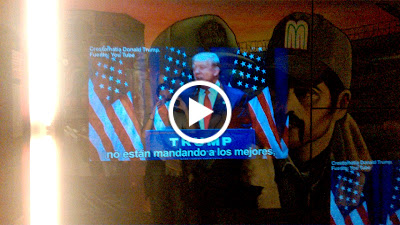
To say that this election season has been a weird time to be a US expat in México is an understatement. When I first arrived to CDMX two months ago, people occasionally asked me about Trump, what I thought about him, and who I was voting for. As the months progressed, news of the election grew more and more widespread-I began to hear discussions of the presidential debates on the radio in the combi on my way to work, and any development in the campaign made front page news. However, it wasn't until I visited the exhibit on migration in the Museum of Memory and Tolerance that I was hit in the face by the reality of this election in Mexico. The Museum of Memory and Tolerance in México City is a massive museum that focuses on human rights, the Holocaust, and other genocides, with a goal of promoting understanding between different peoples. Their interactive exhibit on migration focuses primarily on the experience of Mexican and Central/South American migrants on the journey to the US. I caught my breath as I entered the first feature of the exhibit, which featured a giant mural depicting the US border patrol, La Migra (Mexican border patrol), and the border wall between the US and México. The other side of the room featured several videos playing at once. One video was a compilation of several white US citizen shouting racial slurs towards undocumented migrants. Another was of a white US man who hired a group of undocumented Mexican migrants for a day, claiming he needed them to help him move furniture, only to take them to the local immigration office. This man laughed as he watched the migrants leap from the truck and run across the highway, as if it was some sick joke-which he then uploaded to YouTube. The final video was the now infamous clip from Donald Trump, in which he refers to Mexican immigrants as drug dealers, criminals, and rapists.


The mural in the migration exhibit at the Museum of Memory and Tolerance in Mexico City. 

Fast forward a month and a half, and it is election night. I am in the house of Erika, another US expat, with several of our friends, who hail from México, Canada, France, the United States, and Bolivia. The room hummed with excitement and energy, as we all talked about what it would mean for our respective countries if Hillary were to win. I was impressed by how well informed my non-US friends were about the election, and how concerned they were about the results. I thought about what it would mean to tell my children that I had rang in the election of the first woman president with people from all over the world.

However, as the evening passed and more and more results came in, the mood grew somber. We began to talk about what it would mean for our respective countries if Trump won-what it would mean for healthcare, environmental issues, international relations, and the global economy. I jokingly asked my Canadian friend Tyler how much I would have to pay him to marry me for papers. As a North Carolinian who has taken pride in telling my friends here about the people, food, and geography of my home state, I was saddened to see that my state, which is known as one of the most progressive and forward-thinking in the South, take another step in the conservative direction. As midnight came and went, and it became obvious that the final result wasn't going to be known for several more hours, we went to bed with a sinking feeling in the pit of our stomachs.

The following morning, I woke up knowing that what I saw when I turned on my phone would have implications for the rest of my life. I felt my stomach drop when the first WhatsApp message came in from my friend Maria in Sevilla, offering her condolences for what had happened. I immediately called my mom and broke down crying-crying for my Muslim, immigrant, LGBTQI+, female, disabled, and POC friends, whose lives would now be irrevocably different. In these first few days after the election results, there have already been instances of surge in hate crimes against Muslims, white supremacist graffiti and swastikas, painted across buildings and churches, black people being told to sit in the back of the bus, and white kindergarteners shouting at their Latino/a classmates to ¨Go back to México!¨. My boyfriend, who is a high-school math teacher, told me that one of his students who is Muslim cried for two hours straight when she first heard the news. Another teacher at his school, who has a transgender daughter, wept for fear of what the future would look like for her child. In this first week after the election, many people have been left to wonder what will happen to their rights, their families, and their futures.


The group at the elction watch party. 

After pulling myself together, I went to the office, where my coworkers immediately greeted me with long, silent hugs. Throughout the day, I had some of the hardest conversations I've had yet in México. ¨How could this happen?¨ ¨How could he have won?¨ ¨What does this mean for México?¨ The ¨Trump effect¨ began to hit Mexico before the final results of the election were even announced, causing the peso to hit record lows, and threatening the livelihood of many people here in México. My coworkers expressed concern for the Mexican and global economy, wondering if we are headed yet again to another global recession. They wondered what would happen to all the migrants from Central and South America if they would be unable to enter the US, and if México would be able to absorb them. They discussed a movement in México to boycott US products and companies in light of Trump´s win. ¨No sabía que Estados Unidos tuviera tanto odio.¨ ¨I didn't know that the US had such hate in it.¨ I commented to my coworkers. There response hit me like a punch to the gut. ¨Lo sabiamos.¨ ¨We did.¨

The tough conversations continued when I got home from work. Nef greeted me with a long hug, as any good dad would, and said he was so sorry for what had happened. He and Dani expressed disbelief and shock, saying they had no idea that the US was this misogynistic, and that they expected this kind of stuff to happen in México, not the most powerful country in the world. They said they wanted to see me again after this year, but now aren't sure they ever want to visit the US-or if they would even be able to. They expressed concern for the Mexican economy, wondering if they would lose their jobs, and have to find work in another country, and worrying especially for their loved ones who work paycheck to paycheck. They thought of their loved ones in the US, both those with documents and those without, and what would happen to them and their families. ¨I know someone who is undocumented in the US, but his young children were born there and are US citizens¨, worried Dani. ¨If he and his wife are deported, I don't know what is going to happen to his kids¨. I think a comment from one of Dani´s coworkers sums up the current mood in México best: ¨No sabiamos que los gringos nos odiaran tanto¨. ¨We didn't know that the white people hated us so much¨.

Debating the pros and cons of each former candidate is now a moot point. I can only speak to my personal experiences and feelings. And the truth is, I'm terrified. I'm terrified that our president-elect is man with no political or military experience, who has insulted people of color, LGBTQI+ people, people with disabilities, and Muslims, to name just a few. As a proud feminist who worked throughout college in sexual assault prevention education, I am terrified that he has openly bragged about sexually assaulting women. I was excited to have a woman leading the most powerful office in the world, and what that would mean for gender equality everywhere. I also recognize that many people who supported Trump have been some of the most marginalized and forgotten in a changing economy, and are now some of the most vulnerable to his proposed future policies.
But right now, my heart primarily breaks for my host community, who have welcomed me with open arms, hearts, and home, who our president elect has called druglords, criminals, and rapists. Because the truth is, as a white, heterosexual, upper-middle class, able-bodied, cisgender, college-educated US citizen,  I have about as much privilege as anyone can. And I know that in July 2017, I will be able to cross back over the border to a life relatively protected from the actions of a Trump presidency, not knowing what will happen to my host community after I leave. The results of Trump's election will affect México for years to come, and Trump´s win is certainly affecting their perception of us. ¨This does not line up with my image of the US¨, Dani told me. ¨The people from the US I have met have all been open-hearted and kind. I didn't know the US could be like this. I worry for Mexicans who don't know any US citizens, and think that this is what all people from the US are like. My idea of the US is now changing.¨


Clip from Trump's speech at the Museum of Memory and Tolerance. 

When I wrote the first draft of this blog post, I couldn't think of any words of faith or unity in the face of challenges with which to end this post. However, during this tumultuous week, I realize that I have been surrounded by inspiration. I have been inspired by my host dads, who when I texted them in a panicked state on election night, toId me that they loved me and that everything will be alright. I have been inspired by my coworkers, congregation, and host community, who have only shown me support and kindness, never judging me based on the country I come from, nor the extreme actions and words of some in said country. Although they have as much right to be angry as anyone, they instead choose grace and openness. I am inspired by the people taking to social media, volunteer organizations, and the streets, fighting for the most oppressed. Protests and marches are a good and important part of our nation's history, and  in my opinion, does not show a disdain for our country, but rather a desire for it to become a more perfect union. I also take hope in the scripture quoted by Hillary in her concession speech. "Let us not become weary in doing good, for at the proper time we will reap a harvest if we do not give up." (Galatians 6:9)

As an expat abroad, I have been the recipient of so much beautiful good and welcome during my time in México. I am called this year to live and learn alongside my host community here in México. However, I am equally called to continue my work for justice and equality at the end of this year, when I return back to the United States.  I hope and pray for the space for honest and necessary dialogue during this divided time, and that we work to lift up the very real concerns of the most vulnerable among us, both within our own country, and abroad. For, "The King will reply, 'Truly I tell you, whatever you did for the least of these brothers and sisters of mine you did for me´" (Matthew 25:40). And most of all, I hope and pray that we remember that regardless of our country or nationality, we are all bound by the same ties as children of God-ties that no border or wall can break.